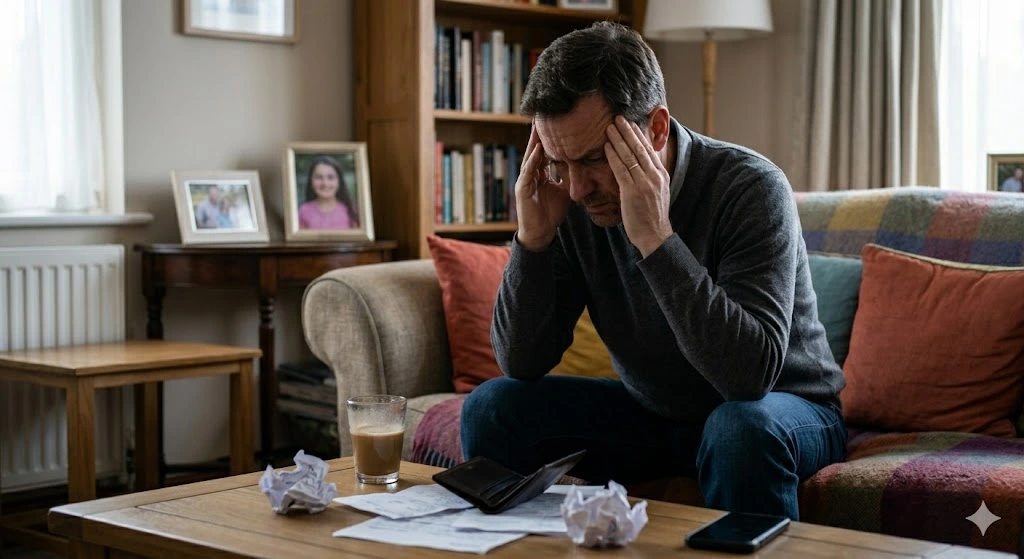
If you can’t manage your anxiety, it’s not your fault—anxiety has specific causes, and your brain is working exactly as it has learned to. Managing it isn’t a matter of “willpower”—it’s a matter of understanding and getting the right support.
You wake up in the morning, and before you’ve even opened your eyes, your mind has already started racing. Thoughts, worries, hypothetical scenarios. Your body is already “tensing up”—chest, stomach, jaw. And you ask yourself: why can’t I stop this?
If this sounds familiar to you, you’re not alone. And the fact that you’re seeking help is, in itself, the first step in the right direction.
Why do I feel like anxiety controls me, and not the other way around?
Anxiety controls you when your brain is “stuck” in alarm mode. This isn’t a weakness—it’s biology.
Our brain has a very ancient function: to protect us from danger. The problem? It doesn’t always distinguish between a real danger (e.g., an oncoming car) and an imaginary one (e.g., “what will others think?”).
When this function is triggered too often or for no reason, we start to feel that anxiety is our “normal” way of being. And then we think that “this is just who we are”—when in reality, this is a behavior we have learned. And whatever has been learned can be changed.
The cycle that “traps” anxiety:
Worrying thoughts → Physical tension → Avoiding the situation → Temporary relief → Anxiety returns even stronger
How do I know when my anxiety has gotten out of control?
There are clear signs that anxiety has become a “constant companion” and isn’t just “stress from a bad day.”
Take an honest look at the following:
Physical signs
Psychological signs
Signs in your life
Difficulty sleeping
Constant worry
Avoiding situations
Tightness in the chest
Catastrophic thoughts
Difficulty at work
Headaches, aches
Difficulty concentrating
Withdrawing from friends
Rapid heartbeat
Sense of impending doom
You don’t enjoy anything
Stomach discomfort
Irritability for no reason
Procrastinating on decisions
If you recognize 3 or more of these, your anxiety needs serious treatment—not just “relaxation.”
What DOESN’T work when you can’t control your anxiety?
There are things that seem like a “solution” but actually keep your anxiety alive.
The most common “mistakes”—which are completely understandable—are:
Avoidance: The more you avoid what stresses you out, the more your anxiety grows. The relief is temporary.
“Not thinking”: The mind cannot be turned off on command. Suppressing thoughts makes them stronger.
Constantly asking others: Seeking reassurance provides temporary comfort but reinforces dependence.
Alcohol or other “sedatives”: They provide temporary, superficial relief—the anxiety returns.
“Hanging in there” without help: It’s not enough—something needs to change in the way the system works.
What can you do right now—practical steps for today?
There are specific techniques that help IMMEDIATELY calm the nervous system, even if only temporarily. They don’t cure the problem on their own, but they provide relief in the moment.
1. The 4-7-8 Breathing Technique
Inhale for 4 seconds → Hold for 7 seconds → Exhale for 8 seconds. Repeat 3–4 times. This technique activates the parasympathetic nervous system—the one that “turns off” the alarm.
2. The 5-4-3-2-1 Technique
When you feel like you’re “losing yourself” to anxiety: Say out loud 5 things you see, 4 you hear, 3 you can touch, 2 you smell, 1 you taste. It brings your mind back to the present.
3. Movement — even a little
10 minutes of brisk walking significantly reduces tension. Movement “burns off” the stress hormones that have built up.
4. Write down what’s stressing you out
Get those thoughts out of your head and onto paper. This alone reduces tension—it gives your brain a little “break.”
Important note:
These techniques provide immediate relief. They DO NOT replace professional help. If your anxiety is affecting your daily life, work, or relationships, you need more than this.
When does anxiety require professional help?
If your anxiety lasts longer than a few weeks or significantly affects your life, professional help isn’t a luxury—it’s the most sensible choice.
Especially if:
You wake up feeling anxious almost every day
You avoid situations or people because of anxiety
You have physical symptoms with no medical explanation
You feel like you “can’t take it anymore”
Your anxiety is affecting your relationships or your work
…then it’s time to talk to a specialist.
At Healthcure Ygeasis, individual psychotherapy is designed precisely for this: to understand why your anxiety works this way and to learn to gradually change the way your mind responds. We won’t just tell you to “relax”—we’ll work together, step by step.
Psychotherapy or relaxation? What really makes the difference?
Psychotherapy isn’t just “talking about my problems”—it’s a structured way to change how your mind works.
Relaxation techniques (on their own)
Psychotherapy
Provide temporary relief
Address the causes
Help in the moment
Permanently change the way you think
Don’t change the “patterns”
Work on deeper patterns
Depend on your consistency
With professional guidance
Not sufficient for severe anxiety disorders
Effective even in cases of intense anxiety
Frequently asked questions about anxiety with answers
Can anxiety go away on its own?
In mild cases, yes. In chronic anxiety that lasts for weeks or months, it rarely goes away without some intervention—and often gets worse if left untreated.
Do I need medication?
Not necessarily. Psychotherapy is effective for many forms of anxiety without medication. Medication is prescribed only by a psychiatrist, depending on the severity of the condition.
How many sessions do I need?
It depends on each case. Many people see a significant difference in a few months—others choose a longer-term collaboration for deeper change.
Does online psychotherapy work?
Yes—the scientific community has confirmed that online psychotherapy is just as effective as in-person therapy for managing anxiety. At Healthcure, we offer both formats.
When should I contact a specialist?
As soon as you feel that anxiety is affecting your daily life—you don’t have to wait until you reach a crisis point. The sooner you seek help, the easier the journey will be.