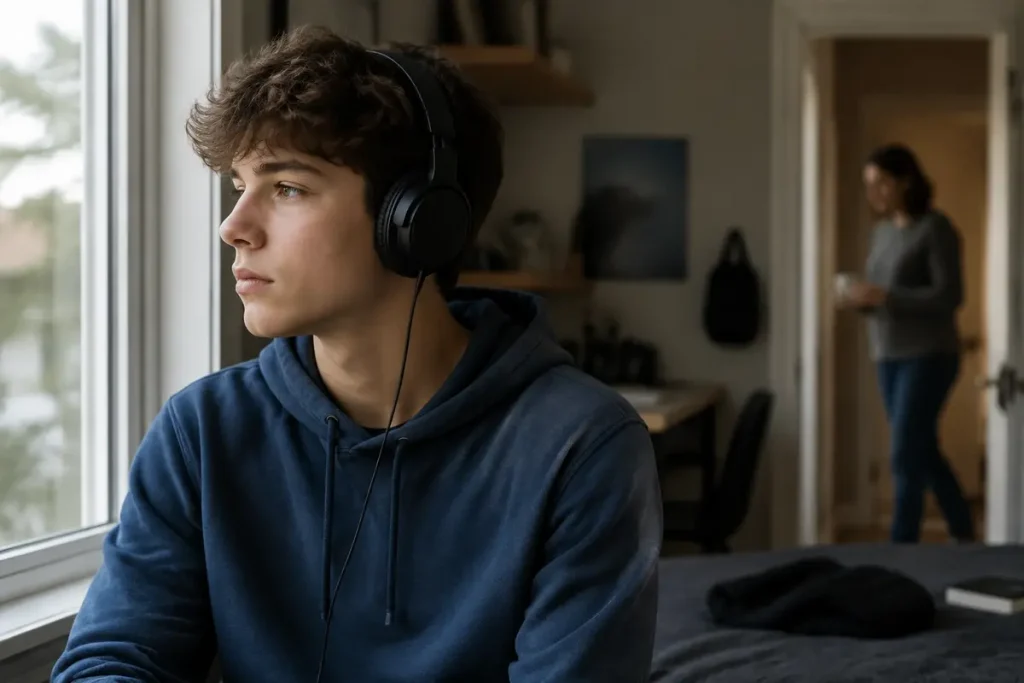
How to Deal with Adolescence: Why Your Child Isn’t “Difficult”—They’re Just Growing Up
“I don’t recognize him anymore. How do I deal with adolescence?” I hear this phrase almost every week from parents of teenagers. A child who, until recently, told you everything, now slams their bedroom door shut. They give one-word answers. Or, worse, they react angrily to something that wouldn’t have bothered them at all six months ago.
Every parent’s first instinctive fear is: “What did I do wrong?” The second, often worse: “What’s going to happen now?”
Let’s start with something that might offer a little relief: your child isn’t going off the rails. They’re growing up. And adolescence, as much as it may seem like a crisis, is actually the most natural developmental process they’ll ever go through.
What Really Happens in a Teenager’s Brain
It’s not a matter of character, nor is it “poor parenting.” It’s biology. A teenager’s brain is undergoing one of the most intense phases of restructuring in a person’s entire life—second only to the early years of infancy.
The frontal lobe—the part of the brain responsible for judgment, impulse control, and long-term thinking—is the last part to complete its development—usually around age 25. This means that your teenager literally doesn’t yet have the full capacity that would allow him to think like you do before reacting.
At the same time, the brain’s reward system—the part that drives them to seek out new experiences, social acceptance, and risk—is hyperactive. The result: a teenager who feels things more intensely, reacts more quickly, and values the opinions of his friends more than yours. Not because they don’t love you. It’s because that’s exactly what their brain needs to do at this stage so they can build their own identity.
Parents need to work together seamlessly during their child’s teenage years. The greatest gift they can give both themselves and their child is to seek parental counseling.
Why They’re Pulling Away—and Why It’s Not Personal
One of the hardest truths I’ve ever told parents: the distance your teenager is putting between you isn’t a rejection. It’s part of growing up.
Think of it this way. Until age 10 or 11, your child saw the world through your eyes. Your opinion was the truth. Adolescence is the time when they begin to build their own, distinct perspective—and to do that, they need to pull away a little first, to experiment, make mistakes, and question things.
It’s like learning to walk, but now they’re doing it with their identity instead of their feet. They’ll stumble. They’ll treat you in ways you didn’t teach them. And the most important thing you can do isn’t to stop them—it’s to stay there, steady, without taking it personally every time.
Signs That Are Normal (and Those That Aren’t)
Here’s something many parents don’t know how to distinguish: there’s a big difference between the normal turbulence of adolescence and something that requires attention.
Normal: mood swings, a desire for more privacy, heated arguments that wouldn’t have happened before, prioritizing friends over family, experimenting with style, music, and opinions.
Caution is needed: complete isolation from everyone, even friends. A sudden, unexplained drop in school performance. Changes in sleep or eating habits that last more than two or three weeks. Talk of worthlessness or despair. Self-harm or references to it.
The second set of signs isn’t “just adolescence.” These are signs that you should always take seriously and seek help for, no matter how much your teenager tells you, “I’m fine.”
How to Talk to a Teen Who Doesn’t Want to Talk
The most common mistake: pestering them with questions. “What happened today?” “Why are you acting this way?” “Tell me what’s bothering you.” The teen experiences this as an interrogation, not as genuine interest, and withdraws even further.
Instead, try something different. Talk beside them, not across from them—literally. In the car, on a walk, in the kitchen while you’re cooking. Without eye contact, teens open up much more easily.
Leave the door open without pressuring them. “I’m here whenever you want to talk” is something you say once, not ten times.
Don’t react immediately to whatever they tell you. If your teen shares something difficult and your first reaction is panic or criticism, they’ll learn: “I can’t tell her/him.” Listen first. React later.
Respect “not now.” It doesn’t mean “never.” It means “not right now.”
Technology isn’t the enemy—but it needs to be discussed
Many parents focus their concerns on cell phones, social media, and how many hours their teenager spends in front of a screen. It’s understandable, but often the wrong target. The issue isn’t so much the time itself as what that time is replacing—if screen time is taking the place of sleep, physical activity, or face-to-face interaction with friends, then it warrants attention. If it’s simply the way your teen stays in touch with their friends, it’s part of their social life, not a threat to it.
Boundaries aren’t the enemy of the relationship
Many parents, afraid of “ruining” their relationship with their teenager, let boundaries dissolve completely. The result is often the opposite of what they want: without a stable framework, the teenager feels less secure, not more free.
Boundaries don’t have to be strict or punitive to work. However, they need to be clear, consistent, and—very importantly—negotiable where it makes sense. A teenager who helps set certain rules (curfew, screen time) is much more likely to follow them than one who simply accepts them as given.
If you’re looking for more specific tools on how to set boundaries without conflict, we’ve analyzed the topic in depth in the article “Setting Boundaries for Children Without Yelling”—the principles apply equally to teenagers, with the appropriate adjustments.
The Mistake Most Parents Make
I’ve seen the same pattern dozens of times. The parent, frightened by the distance they feel, tries to “win back” the teenager by applying more pressure—more questions, more control, more insistence on finding out what’s going on. And the more they pressure them, the deeper the teenager withdraws. It’s a vicious cycle that feeds on itself.
The opposite—leaving the teenager completely to their own devices, without any interest or guidance—is not a solution. It’s simply the other extreme of the same problem.
What really works—and I see it time and time again in families who practice it—is something more difficult than either extreme: a steady, low-key presence. Being there without being intrusive. Asking questions without interrogating. Showing interest without micromanaging every detail. It sounds simple in theory. In practice, it’s one of the hardest things you’ll do as the parent of a teenager—and it’s completely normal not to get it right all the time.
When Tension Goes Beyond “Normal”
There are times when, no matter how hard you try, your relationship with your teenager seems to have reached a dead end. Daily arguments. Silence that lasts for weeks. A child who tells you outright, “You don’t respect me” or “You never understand me.”
This doesn’t mean you’ve failed as a parent. It means that the dynamics of the relationship need a third, neutral party to help reestablish communication. Parenting counseling provides exactly that—practical tools tailored to your specific child, not generic advice from a book.
And if your teen is showing signs that truly worry you—withdrawal, a decline in performance, persistent mood changes—child psychology can provide them with a space of their own, without you present, where they’ll feel comfortable talking.
Adolescence isn’t something that “just passes.” It’s something you go through together—and that makes all the difference.
If you feel you need support, whether for yourself or for your child, schedule an appointment and let’s figure it out together.
Frequently Asked Questions About Adolescence
At what age does adolescence begin and end?
Biologically, it usually begins around ages 10–12, and the brain continues to mature fully until ages 24–25. This doesn’t mean 15 years of turmoil—the most intense phase is usually between ages 13 and 17.
Is it normal that they don’t tell me anything anymore?
To a certain extent, yes—privacy is part of their identity development. But if you feel completely cut off, with no moments of connection at all, it’s worth exploring this together, perhaps with some help.
When should I be seriously concerned about my teenager?
When the changes aren’t just mood-related but functional—they’re not going to school, aren’t seeing any friends, and aren’t sleeping or eating normally.
When should I be seriously concerned about my teenager?
When the changes aren’t just mood-related but functional—they’re not going to school, aren’t seeing any friends, aren’t sleeping or eating normally, or are talking about feeling hopeless. At that point, it’s no longer just “typical adolescence.”
Should I enforce the same rules I had as a teenager?
Not necessarily. The world has changed—social media, digital pressure, different social norms. The principles behind the boundaries (safety, respect, consistency) remain the same, but applying them requires adapting to your child’s reality today, not to your own experience from thirty years ago.