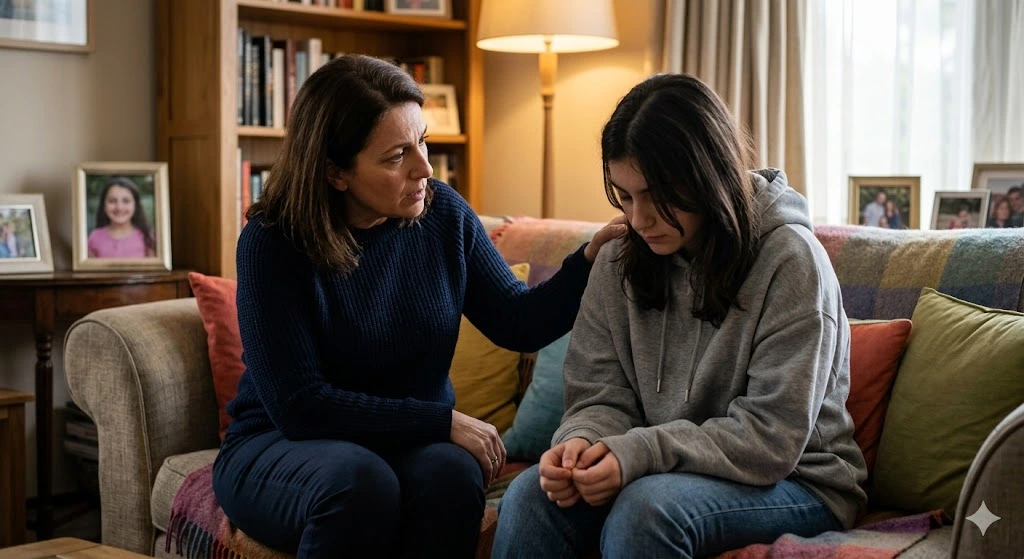
My daughter lacks self-confidence: 8 ways to help her without making mistakes
Low self-confidence in girls isn’t a “personality trait”—it’s something that develops. And precisely because it develops, it can also change. You, as a parent, play the most important role.
“Mom, I can’t do it.” “I’m not good at anything.” “Everyone is better than me.”
If you’ve heard these phrases from your daughter, you know how you feel: worried, perhaps helpless, perhaps guilty. And you wonder—what did I do wrong? What can I do?
First of all: the fact that you’re noticing this and looking for ways to help is already very important.
What does “low self-esteem” mean in children?
Low self-esteem is a child’s inner belief that “they aren’t enough”— — not smart enough, good enough, or lovable enough.
It doesn’t always show up the same way. Some children are quiet and withdrawn. Others become aggressive or the “class clown” — seeking acceptance.
Common signs:
Refuses to try new things (“I won’t be able to do it”)
Gives up easily when things get difficult
Constantly compares herself to others
Has a hard time accepting compliments (“as if…”)
Is afraid to express an opinion in front of others
Often says “I don’t know” or “whatever you want”
Worries excessively about what others think
Why does my daughter have low self-confidence? What’s the cause?
It’s not just one thing—and it’s almost never solely your fault. Self-confidence is shaped by many factors working together.
Factor
How it affects
Family environment
The way we communicate, what the child sees
School experiences
Failures, peer relationships, assessment methods
Social media / Internet
Comparison with “perfect” images, comments
Child’s temperament
Some children are naturally more sensitive
Significant events
Divorce, loss, changing schools, bullying
Note for parents: Asking yourself “What did I do wrong?” is understandable—but it doesn’t help. What does help is focusing on what you can do NOW.
8 Ways to Help Your Daughter Build Self-Confidence
Self-confidence is built through specific, everyday actions—not just words.
Praise the effort, not just the result. Instead of “good job getting an A,” say “I’m glad you studied so hard.” This teaches her that her worth doesn’t depend on the result.
Let her make mistakes—without jumping in right away. Mistakes are the most powerful source of learning. If you rush to “save” her every time, you’re sending her the message that she isn’t capable.
Ask for her opinion—and really listen to it. “What do you think?” This simple question shows her that her opinion matters.
Don’t compare her to other children—ever. Even “positive” comparisons (“you’re better than so-and-so”) create competition instead of self-confidence.
Help her find something that excites her. A hobby, a sport, an art form. The experience of success in an activity she loves builds self-confidence much more quickly.
Speak positively about yourself in front of her. Children “copy” the way parents talk about themselves. If you constantly say, “I’m useless,” she learns that pattern.
Show her that you make mistakes too—and keep going. “I made a mistake; what can I learn from this?” This is one of the most powerful messages you can send.
Respect her feelings. Don’t dismiss her anxiety or fear (“that’s silly”). Instead: “I understand that this is hard. What can we do together?”
When is more than parental support needed?
Sometimes low self-esteem has deeper roots that the family alone cannot address.
Contact a specialist if your daughter:
Refuses to go to school or avoids social situations
Speaks very negatively about herself (“I’m not good enough,” “I’m ugly”)
Seems constantly sad or anxious
Has lost interest in things she used to love
Has expressed thoughts of harming herself
Child psychology doesn’t mean that “something is broken”—it means that your child deserves special support in a safe environment where she can speak freely without worrying about you.
At Healthcure Ygeasis, we work with children and adolescents, helping them build a healthier relationship with themselves—and at the same time, we support parents so that change can take place throughout the entire family.
Frequently Asked Questions from Parents
At what age does low self-esteem begin to appear?
It can appear very early on—even as young as 4 or 5 years old. It often becomes more apparent during adolescence, when social pressure and the need for acceptance increase.
Do I need to go to the psychologist with my child?
In Parent Counseling, yes—there are sessions that include the parent. Often, the parent’s involvement is just as important as the work done with the child.
Will the psychologist say anything “against” us?
The psychologist doesn’t judge parents—they help the child. What the child shares in the session is confidential, unless there’s a safety issue.
How long does it take to see changes?
It depends on each child. Many parents see small, positive changes within a few weeks. Significant changes in attitude and behavior are usually noticeable within a few months.
Can it be done online?
Yes—we also offer online sessions, especially for teenagers who feel more comfortable in their own space.