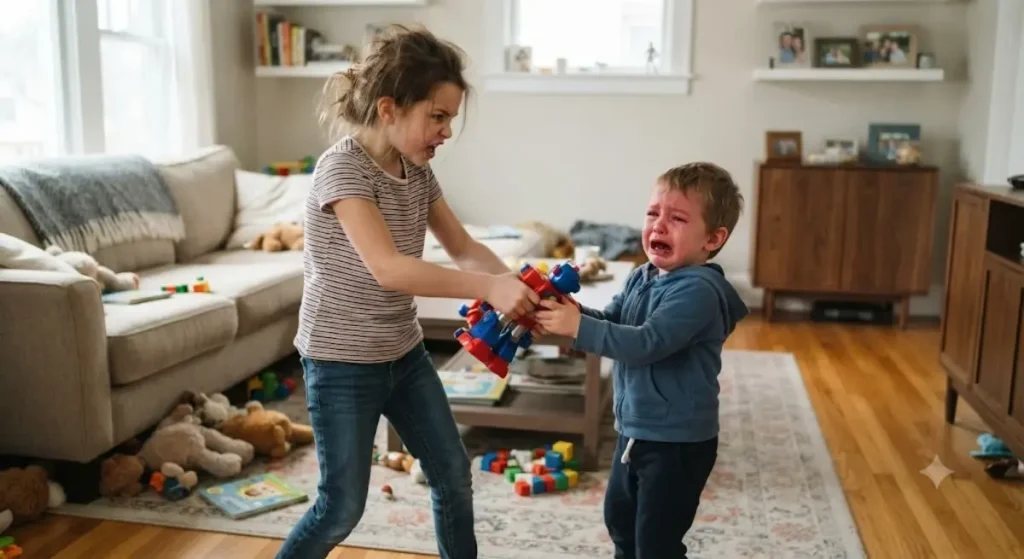
“You don’t love me as much as you love Maria.” Hearing this phrase from a 6-year-old can really break your heart. I’ve heard it described in therapy sessions dozens of times, with different names each time, but with the same pain behind it. And if you have more than one child, you surely know what I mean—that tension that never completely goes away, it just changes form as they grow up.
Sibling rivalry isn’t a sign that you’re doing something wrong as a parent. It’s, at its core, a very natural way for two children to learn to share something precious—your attention. The problem isn’t that it exists. The problem is how we handle it.
Many parents come to me feeling guilty, as if they’ve failed because their children aren’t always the “perfect picture” of sibling love they imagined before having a second child. Let’s be clear: competition doesn’t mean a lack of love between them. Very often, the same children who fight fiercely in the morning sleep in the same bed at night because they feel safer that way. This contradiction isn’t paradoxical—it’s simply what a real sibling relationship looks like.
The mistake that’s repeated in every home
The most common mistake isn’t comparing children—though that, too, is very harmful. It’s something more subtle: the effort to be “fair” in a perfectly equal way, at every moment, with every child. It sounds right. In practice, it has the opposite effect.
Why? Because children don’t need equal treatment. They need treatment tailored to their own needs, their age, and their personality. A 4-year-old and a 9-year-old don’t need the same things at the same time, and when you try to give them exactly the same things—the same amount of time, the same gifts, the same rules—in the end, neither of them feels truly understood.
Sibling Rivalry: What Lies Behind the Arguments
When two siblings fight over a toy, it’s rarely really about the toy. Behind it lies a question that no child will ever put into words: “Who do you love more?” It’s not meanness. It’s fear. The fear that love is a finite resource and that, if the sibling takes it, there will be less left for them.
This is the key point that many parents overlook. You’re not trying to stop the fight over the toy. You’re trying to answer the unspoken question.
Do age difference and birth order play a role in sibling rivalry?
Yes, quite a bit. Two children with a small age gap—say, one and a half to two years—often compete more intensely because they’re at nearly the same developmental stage and are vying for the same resources, the same toys, and the same space. With a larger age gap, competition often decreases, but it doesn’t disappear—it simply changes form, from “who gets the toy” to “who gets more freedom, more trust.”
Birth order also plays a role, though not in the absolute way that online articles often claim. The oldest child often feels they have to be the “responsible one,” the “role model”—and this creates a silent pressure that can manifest as anger toward the younger sibling, especially when they feel that the younger sibling “gets off easy.” The younger child, on the other hand, grows up seeing the older sibling enjoy privileges that they do not yet have, and this fosters a different kind of jealousy—one that is more comparative, more persistent.
You don’t need to memorize theories about birth order. Just remember that every child in the family experiences a different version of the same family—and both versions are equally true.
What Psychology Says About Sibling Jealousy
Sibling jealousy is not a character flaw. It is, at its core, a very early form of the fear of abandonment. A child who sees a parent hugging their sibling does not rationally think, “There’s enough love to go around.” On a more primal level, they feel a threat to their survival—because for a young child, the bond with a parent literally equates to safety.
This explains why jealousy often manifests more intensely after the birth of a new sibling—the older child may suddenly start wetting the bed again, speaking “baby talk,” or ask to be bottle-fed again. They aren’t regressing because something is wrong with them. They’re regressing because they’re trying, in the only way they know how, to get back what they feel they’ve lost.
Practical Steps That Really Work
Give each child separate, scheduled time with you—even just 15 minutes a day, just the two of you, without your phone, without the other child interrupting. That sounds like a small thing. It isn’t. A child who knows they have their own, set time with you will compete much less for your attention during the rest of the day.
Avoid comparisons, even when they seem harmless. “Your brother didn’t yell that much when he was your age” isn’t a fact—it’s a comparison that hurts, even if you don’t mean it that way, and over time it can lead to low self-esteem in the child.
Don’t always step in as the referee. If you intervene every time the kids fight and decide who’s right, they’ll never learn to resolve their differences on their own—and they’ll keep coming to you every time, as if they need a judge. Give them space, when the situation isn’t dangerous, to work it out on their own.
And here’s something that’s often overlooked: acknowledge their feelings, not just their behavior. Instead of “stop yelling,” try “I understand that you got angry when he took your toy.” A child who feels that their emotion has a name and is accepted doesn’t need to express it with such intensity the next time.
Also avoid fixed “roles” within the family—“he’s the quiet one, she’s the lively one.” As innocent as they may sound, such labels stick to a child like an identity, and one child may feel they have to “maintain” their role even when it no longer fits them, while the other feels trapped in an image they didn’t choose. Give each child the space to be different every day, without constantly being compared to their sibling’s role.
When Competition Becomes Something More
There is a line between normal sibling rivalry and something that requires professional attention. If a child shows intense, persistent hostility toward their sibling, if physical violence or rejection occurs, or if one of the children begins to show signs of anxiety or sadness that seem linked to this relationship, then it’s worth speaking with a child psychologist—also read our article on how to set boundaries for your child without raising your voice, because consistent boundaries are part of the solution to sibling rivalry as well.
Asking for help here isn’t a sign of weakness. On the contrary, it’s the most responsible thing you can do—because the relationship between siblings is being built right now, and whatever is established now will stay with them as adults, in their own families, one day. If you need guidance more generally as a parent, parenting counseling is designed exactly for that.
Want to learn more about child psychology? – Follow us here!
Frequently Asked Questions from Parents
Is it normal for siblings to never become close friends? Yes, it’s more common than we think. A close friendship between siblings often develops in adulthood, not during childhood or adolescence, when competition for resources and attention is more intense. Your role isn’t to force them to become “best friends” right now, but to give them the tools—respect, communication, and security—so that this relationship can blossom later, whenever they’re ready.
What should I do if I clearly favor one child over the other? First of all, you’re not the only one who feels this way—it’s more common than people admit, and it doesn’t make you a bad parent. What matters isn’t the feeling itself, but whether it affects your behavior. If you notice that you speak differently, give different amounts of time, or make excuses for one child more readily than the other, this is something worth working on—ideally with guidance, because children sense it, even when you don’t say it out loud.
Do I have to punish both children when they fight, even if they aren’t equally at fault? Not necessarily. “Equal punishment” seems fair on the surface, but it teaches the child who isn’t at fault that it’s not worth the effort to control themselves—since they’ll be punished anyway. It’s better to try to understand what really happened, no matter how difficult that may be in practice.
If you feel that competition in your home has gone beyond what’s normal, or you simply want a roadmap to manage it properly from the start, there’s a solution so you don’t waste any more time.
You can schedule an appointment, and we’ll go through it together, step by step.