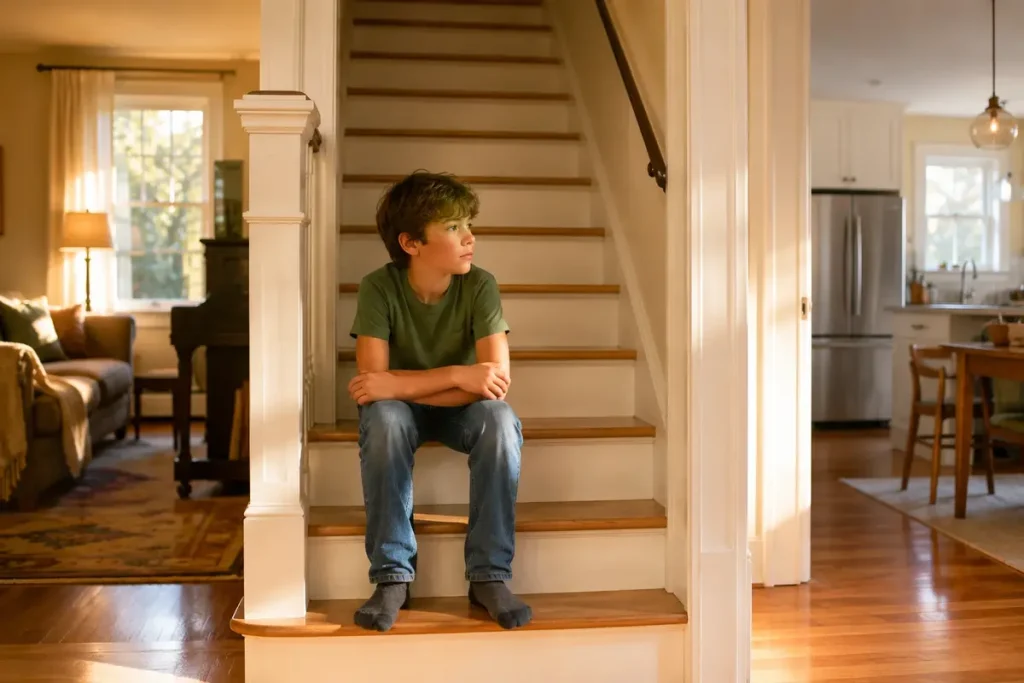
“I feel like I’m depriving him of something.” I heard this from a father, a single parent of two children, during our first meeting. He wasn’t talking about money or time. He was talking about something deeper—the belief that, because there was no second parent at home, his children would grow up somehow “incomplete.”
This belief, however understandable it may be, has no basis in reality. And the worst part? It is precisely this guilt—not single-parenting itself—that often causes the most damage to daily life at home.
A single-parent family is not an “incomplete” family
Let’s be clear: a child doesn’t need two parents under the same roof to grow up emotionally healthy. They need stability, security, and at least one adult who is emotionally available and consistent for them. A single parent can provide this just as well as two—sometimes even better, especially if the alternative were a home filled with tension between two parents who didn’t get along.
The word “single-parent” carries a social stigma that doesn’t correspond to reality. Families become single-parent households for a thousand and two reasons—divorce, widowhood, choice, a partner’s departure. The “how” doesn’t determine the outcome. What determines the outcome is how daily life functions within that home.
Why Your Guilt Is the Real Problem
A single parent’s guilt usually manifests in one of two ways—both of which create problems.
Overcompensation. The parent tries to “make up for” the absent other parent by doing everything themselves, not setting boundaries for fear of “depriving” the child of anything else, and saying yes to every request. The result is not a happy child—it is a child without a stable framework, who learns that the parent’s guilt is a bargaining tool.
This is a constant anxiety that the child senses. Children are extremely sensitive to their parents’ emotions, even when they aren’t expressed in words. A parent who constantly carries the burden of “I’m not good enough for them” unintentionally passes this on to the child—who then begins to wonder if something is indeed missing.
Your child doesn’t need you to be perfect, or twice as devoted as if there were two of you. They need you to be consistent, present, and—most importantly—free of guilt that makes them feel responsible for your own feelings.
What a Child in a Single-Parent Household Really Needs
Routine. This is more important here than in any other context, because it provides predictability within a structure that already differs from the “typical” models they see around them.
Adult role models outside the home. A child doesn’t need a second parent at home, but benefits from the presence of other stable adults in their life—grandparents, aunts and uncles, family friends, teachers. This is not a “replacement” for the absent parent. It is a natural support network that every child benefits from having.
The right to their own emotions. A child in a single-parent family may, at some point, feel sadness or anger about the absence of the other parent. This doesn’t mean that something is wrong. It means they need space to express it without feeling like they’re hurting the parent who is present.
A parent who also takes care of themselves. This may sound contradictory, but it is perhaps the most important point of this entire article: an exhausted, constantly stressed parent cannot provide the stability a child needs, no matter how hard they try. Taking care of yourself is not a luxury here. It’s a prerequisite.
Financial pressure and how a child perceives it
I can’t write about single-parent families without mentioning something that often goes unspoken in therapy sessions: the financial pressure a single parent feels, and how it subtly affects the child.
A child doesn’t need to know the numbers to understand that something is weighing on their parent. They sense it in the tension in their voice, in the “not now”s that come up more often, in the general exhaustion. This doesn’t mean you should hide reality entirely—children, especially older ones, benefit from a realistic, age-appropriate view of things. It means you need to distinguish between the practical difficulty (“we can’t this month”) and the feeling of inadequacy (“I’m not a good enough parent because I can’t”). The first is information. The latter is guilt you don’t need to carry—and your child certainly doesn’t need to carry it with you.
When Is a Second Parent Truly Missing?
Let’s be honest about a point that’s often overlooked in articles like this: there are things that the absence of a second parent truly changes in everyday life—fewer hands to help with chores, less time to rest, a decision you used to discuss with someone that you now make on your own. This is true, and you don’t need to deny it to yourself by constantly trying to appear “strong.”
The difference is that these practical difficulties don’t automatically mean you’re failing as a parent. You can acknowledge that it’s hard without it meaning your child is missing out on something essential. The two things aren’t the same, no matter how much exhaustion makes you confuse them.
Social Stigma and How to Deal with It
Unfortunately, you still hear comments—from relatives, teachers, and other parents—that imply something is “missing” from a child in a single-parent family. These comments, even when well-intentioned, can reinforce your existing feelings of guilt.
The most helpful thing you can do is to separate your own worth as a parent from these comments. You don’t have to prove anything to anyone. Your child doesn’t judge their family based on how many adults live in the house, but on how stable and secure their daily life feels.
If you notice that your child is receiving comments at school about their family situation, it’s worth taking this seriously—this may touch on issues of a child’s self-esteem that require their own attention.
You don’t have to do everything perfectly. You need to be there, consistently, day by day—and you’re already doing that; otherwise, you wouldn’t have read this article this far.
Single-parent parenting isn’t a lesser version of a family. It’s a different structure that, with the right support, gives a child everything they need, just like any other family.
If you’d like some support along the way, book an appointment and let’s figure it out together.
When It’s Time to Seek Help—For Yourself or Your Child
If you feel constantly exhausted, if guilt has become the dominant emotion in your daily life as a parent, or if you simply want tools to manage parenting on your own without losing yourself, parenting counseling is designed exactly for that—practical support, not judgment.
And don’t forget about yourself. Many single parents put their own mental health at the bottom of their list of priorities, thinking they don’t have the time or the right to prioritize it. Individual therapy isn’t a luxury here—it’s the foundation on which you build the stability your child needs.
If you’re a single parent due to a recent divorce and are still adjusting, the article “Divorce and Children” thoroughly covers the first phase of this transition.
Want to learn more about psychology as it relates to you? – Follow us here!
Frequently Asked Questions About Single-Parent Families
Will my child’s mental health be affected by growing up with one parent?
Research and clinical experience consistently show that what determines a child’s mental health is the quality of the relationship and the stability they experience, not the number of parents in the home. A stable single-parent home is much healthier than an unstable “two-parent” .
How do I explain to my child why our family is different from others?
Simply and without excuses. “There are many different kinds of families, and ours is the two or three of us—that makes us a family just the same.” Children pick up on the parent’s tone, not the facts themselves.
Should I actively seek out a male or female role model for my child?
You don’t need to artificially “create” something like that. It’s more helpful to let the child form natural relationships with consistent adults in their life—grandparents, uncles and aunts, teachers—without pressuring them to “fill in” a specific role.
How do I take care of myself when I don’t have anyone to “take my place” for a little while?
Ask for specific help, not just general assistance. Two hours a week from a relative or friend, a regular appointment in your calendar—even small, scheduled breaks make a big difference in the long run. You don’t have to do it alone, even if you’re a single parent.